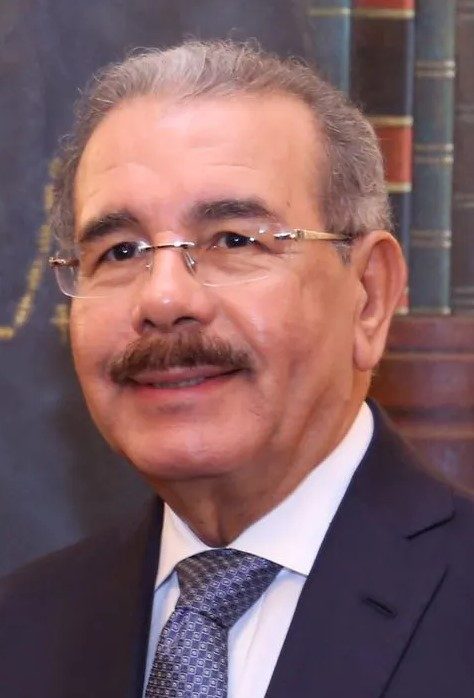
Danilo Medina Sánchez was born on November 10, 1951, in Arroyo Cano, a small town in the Dominican Republic. Coming from a humble, rural background, he pursued a degree in chemical engineering at the Autonomous University of Santo Domingo (UASD) and later earned a degree in economics.
Medina’s political journey began within the Dominican Liberation Party (PLD), where he became a close ally of the party’s founder, Juan Bosch, and later a trusted figure under President Leonel Fernández.
Medina served as:
PLD presidential candidate (2000)—he lost but returned stronger in 2012.
President of the Chamber of Deputies (1994–1995)
Secretary of the Presidency (1996–1999, 2004–2006) under Fernández
Early Life and Political Career
Presidency (2012–2020)
Achievements and Reforms
Danilo Medina entered office in 2012 promising to “go where the people are”— a man of the people, aiming to tackle inequality, poverty, and improve education.
Some of his key achievements:
- Education Reform ("Revolución Educativa"):
- Increased education spending from 2% to 4% of GDP
- Built over 28,000 new classrooms, extended school hours, and launched the School Breakfast Program.
- Made teacher training and infrastructure priorities.
- Economic Growth:
- The economy grew by an average of 5.6% annually during his tenure, becoming one of the fastest-growing economies in Latin America.
- Major infrastructure projects (roads, housing, hospitals) expanded across the country.
- Social Programs:
- Launched the Solidarity Card (a cash transfer program to support low-income families).
- Pushed for agricultural subsidies and small business support.
Controversies and Corruption Scandals
Despite the economic growth, Medina’s administration was deeply marred by corruption allegations that eroded public trust:
1️⃣ Odebrecht Scandal:
- The Dominican Republic was one of the countries hardest hit by the Odebrecht bribery scandal—a Brazilian construction giant that admitted to paying over $92 million in bribes to Dominican officials between 2001 and 2014, spanning Medina’s administration.
- High-ranking officials, including former ministers, were implicated, but Medina himself avoided prosecution, raising accusations of protectionism.
- The Punta Catalina power plant, a flagship project of Medina’s government, became a symbol of corruption—with allegations of inflated costs, opaque contracts, and bribes linked to Odebrecht.
2️⃣ Constitutional Manipulation:
- Medina pushed for a constitutional amendment in 2015 to allow consecutive presidential terms, enabling him to run for re-election in 2016.
- Many saw this as a power grab that weakened democratic norms and divided the PLD.
3️⃣ Nepotism and Political Control:
- Medina’s government was accused of favoritism—appointing allies, family members, and loyalists to key posts.
- The Public Ministry, responsible for investigations, was seen as lacking independence, fueling suspicions of cover-ups.
4️⃣ Press Freedom Issues:
- Journalists faced intimidation, lawsuits, and pressure when reporting on government corruption.
- Medina’s administration was criticized for creating a climate of fear around press investigations into corruption.
End of Presidency and Legacy
Medina left office in 2020 amid widespread disillusionment. While many Dominicans appreciated the improvements in education and infrastructure, a deep sense of betrayal lingered due to the unresolved corruption cases and the sense that the Medina era protected the powerful at the expense of justice.
His successor, Luis Abinader, ran on an anti-corruption platform, pledging to investigate the wrongdoings of the past—further highlighting Medina’s legacy as a president of big promises but broken trust.
Danilo Medina’s Impact on the DR2028 Vision
Medina’s presidency represents a critical moment in modern Dominican politics:
- It showed that economic growth alone isn’t enough—without transparency, justice, and accountability, progress can be hollow.
- It exposed the dangers of constitutional manipulation for political gain.
- It left a lasting public demand for anti-corruption reforms—a key pillar of DR2028’s mission.
Medina’s story is a reminder that the fight for a fair and just Dominican Republic is far from over—and that DR2028 stands as a response to the failures of past leadership.